Two RTO Records, Opposite Implications
PJM set an all-time solar record while ERCOT set back-to-back battery charging records — and the two point in different directions
The US grid broke records in two different RTOs this week, and the implications run in opposite directions.
PJM set an all-time solar record of 14,206 MW on Friday 29 May, then nearly matched it at 14,157 MW the very next day. That's roughly the output of a dozen large natural gas plants, from solar alone.
The build-out in the Mid-Atlantic has been relentless, but the surge is concentrated in a few zones. Dominion in particular has seen tremendous solar development, and it is increasingly running into transmission constraints that create sharp locational price spreads.
Meanwhile ERCOT set back-to-back all-time records for battery charging: 7,661 MW on 31 May and 7,847 MW on 1 June.
The pattern is simple — midday solar saturation drives real-time prices to zero or negative, and storage charges hard. What's changed is the magnitude. Over 7,800 MW of simultaneous charging would have seemed implausible five years ago. Now it's happening two days in a row.
This is where traditional peak, off-peak, and bal-day contracts start to show their limits. When volatility is concentrated in specific hours, a peak strip gives you broad exposure but misses the shape entirely.
Hourly contracts let you express a view on exactly which hours carry the risk or the value:
- The solar saturation window in ERCOT midday.
- The ramp period in PJM late afternoon, when solar drops and demand is still elevated.
The market is reflecting this. We're seeing strong liquidity across the solar ramp hours: HE18–HE20 in PJM HB_WEST had over 105 MW on both bid and ask near the top of the book in the BFUT500 contract, with 83 MW in the BFUT100. ERCOT HB_NORTH ran similarly deep, at 65 MW on each side in both the BFUT500 and BFUT100.
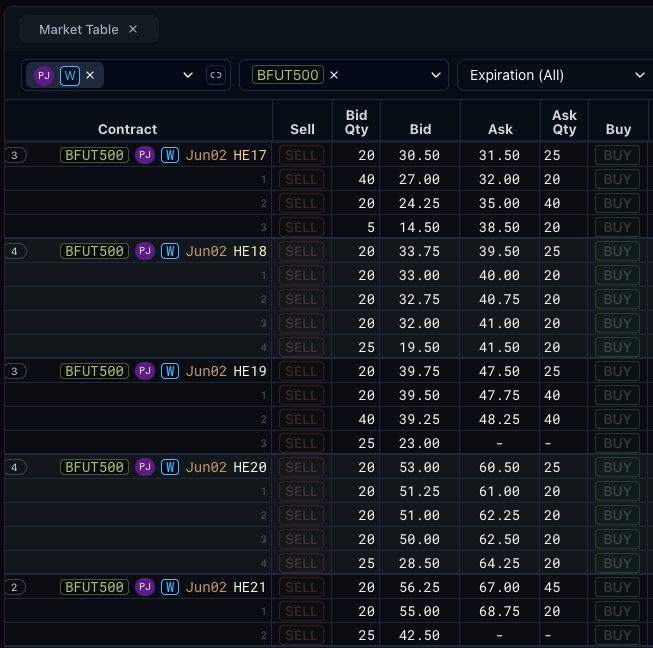
That's real, two-sided liquidity in exactly the hours where the grid is most dynamic. For a retailer or generator trying to hedge solar ramp exposure precisely, that market depth matters. The granularity isn't just useful — it's increasingly necessary to accurately hedge or monetize a load or generation profile.