MISO Tests Its Load Record With a Thinner Cushion
MISO approaches an all-time peak as fading wind and a simultaneously stressed PJM thin out the imports it usually leans on
MISO is about to test its all-time load record, and the squeeze may be even tighter than the peak suggests.
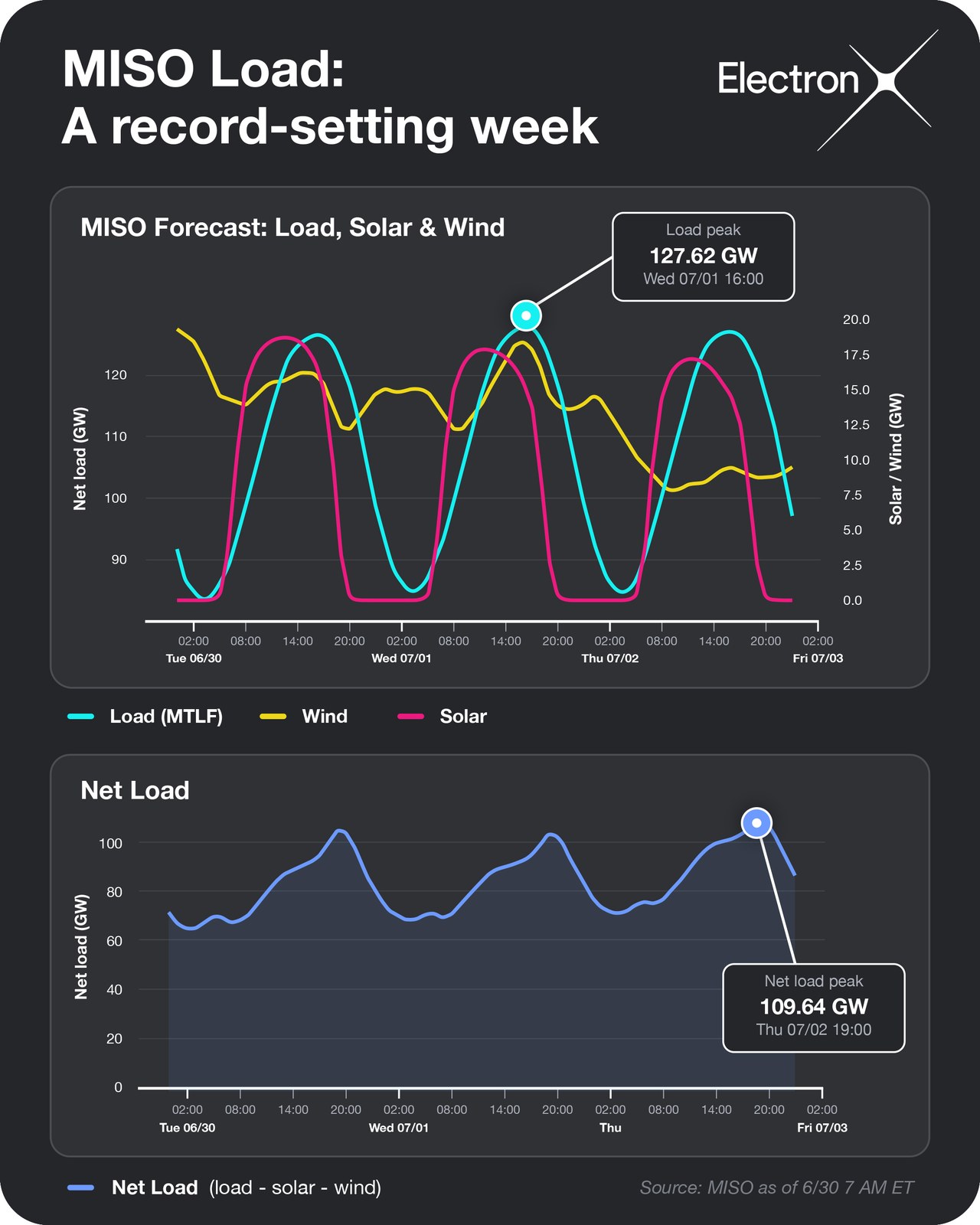
This week's heat is pushing MISO toward a demand peak of roughly 127.6 GW on Wednesday, breaking the ISO's standing record of 127.1 GW. Wind tapers off as the week goes on, so net load keeps climbing even after the headline peak. By Thursday the grid is leaning on fewer renewables and more thermal generation, right when it can least afford slack.
What makes MISO's week even more precarious is what's happening in PJM.
PJM is expected to run hot too, with load coming in above its summer 2026 forecast and above last summer's peak — currently tracking to 166.3 GW on Thursday, which would also break the long-standing all-time record of 165.6 GW set in 2006. Forecast feels-like temperatures, and in some cases actual temperatures, across much of the region are pushing into the triple digits. As the week progresses the strongest cooling load shifts into the I-95 corridor, likely driving strong west-to-east flows.
That tightens the screws on MISO. When PJM has to serve all of its own demand, it has far less power to send west. MISO has historically been able to lean on its neighbours during tight stretches, as it is almost always a net importer from PJM. But if PJM is keeping everything it generates to cover the I-95 corridor, that cushion thins out exactly when MISO needs it most. Record load, fading wind, and fewer imports to lean on, all landing in the same few days.
Records make headlines. Volatility makes markets.
Hourly contracts listed on ElectronX cover both MISO — Indiana, Minnesota, and Louisiana Hubs, plus the PJM interface — and PJM directly, including the MISO interface. The market structure is in place to address the MISO record, the PJM-side flows, and the relationship between them at the hourly level. So whether you're taking a view on the MISO record, the imports it's counting on, or the flows between the two regions, you can trade all of it in one place.