When Peak and Off-Peak Stop Describing the Risk
An emergency transformer outage reshaped basis across PJM in hours the day-ahead market had not priced
There's a reason peak and off-peak categories don't fully describe what happened in PJM.
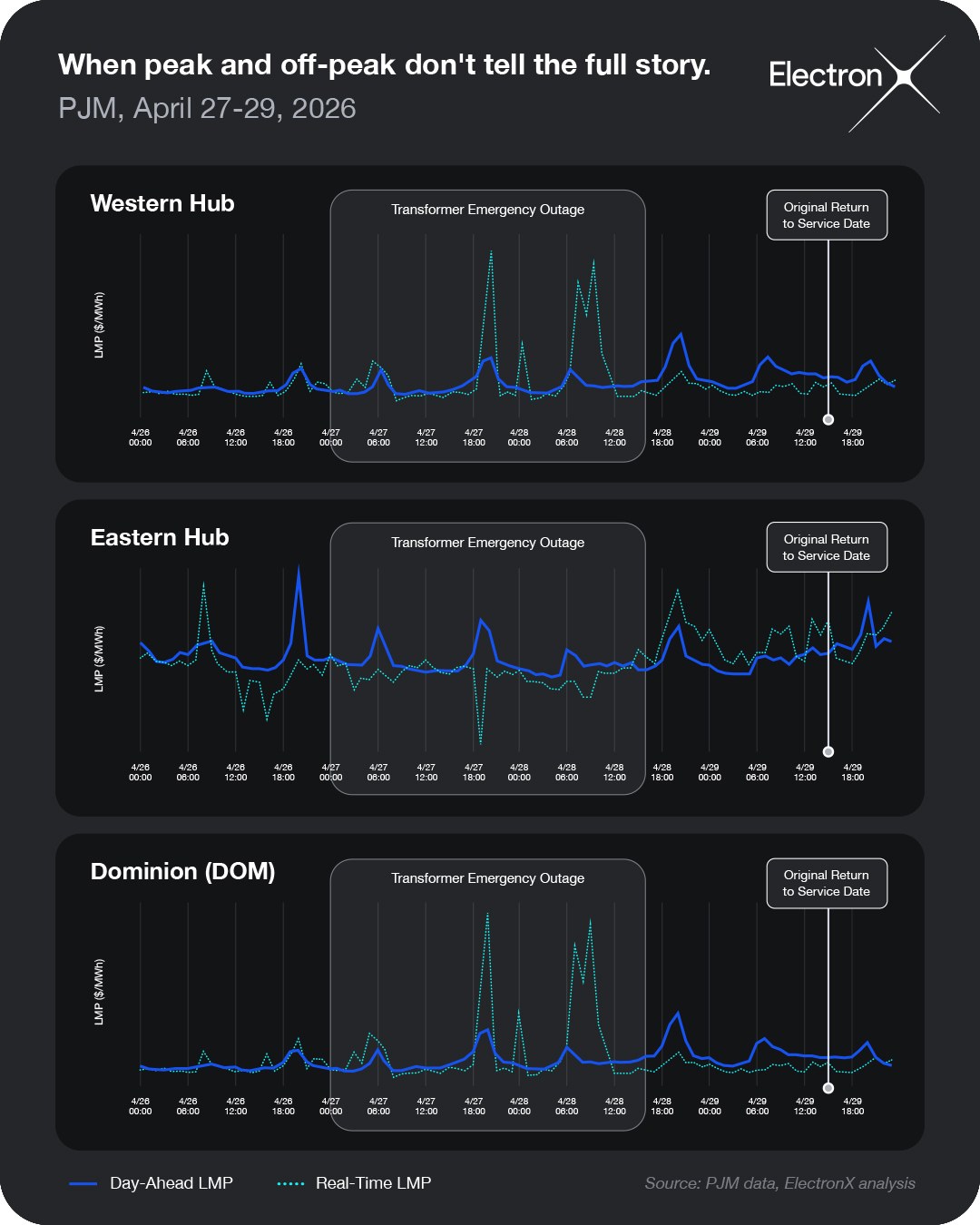
On 27 April, an emergency outage at the Conastone 500 kV XF 2 transformer reshaped basis across the RTO. Eastern Hub real-time prices went sharply negative through south-eastern Pennsylvania, New Jersey, and Delaware. Dominion and Western Hub spiked in the morning, then ripped across multiple hours during the evening ramp.
The outage was filed and approved days in advance of the day-ahead auction. The day-ahead market on 27 April did not fully reflect the risk. Eastern Hub cleared positive in DA yet went negative in real time, with significant negative price volatility. Dominion and Western Hub's DA prices under-forecast what was coming; by the evening ramp, RT had moved well past where DA cleared at both, and stayed there for hours.
When the transformer returned to service the following afternoon the basis flipped, and DART spreads flipped with it — Eastern Hub RT settled above DA, while Dominion and Western Hub both moved the other way. A few things stand out about this kind of event:
- Risk at the RTOs increasingly lives in specific hours around specific events, not across pre-defined legacy hour-class or peak blocks, nor a balance-of-day strip.
- It moves between the day-ahead and real-time markets, which makes INC/DEC virtuals an imperfect tool for participants with physical positions to manage.
A generator in eastern Pennsylvania, New Jersey, or Delaware that wanted to address the congestion on the morning of 27 April had a different option available: hourly futures on ElectronX, sized to the specific hours of exposure. The same applies to a load-serving entity in BGE or Dominion looking at the other side of the same trade. As of 10:00 ET there was over 30 MWh on both sides of the spread near the top of the book for the BFUT500 PJM Western Hub product.
The grid is still adjusting to a generation mix that doesn't follow the old rhythms. Hedging instruments are starting to catch up.