Dominion Zone: Data Center Alley
Power Markets, Data Center Alley, and Structural Price Dynamics in PJM
Secular load growth in the Dominion Zone is outpacing transmission build. That structural imbalance shapes congestion frequency, basis relationships versus Western Hub, and hourly price shape across the instrument stack.
Overview
No single story in North American power markets rivals the transformation of Northern Virginia into the world's largest data center market. Loudoun County alone hosts over 300 data centers, and the footprint continues expanding southward along the I-95 corridor into Prince William, Stafford, and Spotsylvania Counties. By 2046, PJM forecasts a 173% increase in load (PJM 2026 Load Forecast Report), while Dominion's IRP filings show system-wide growth scenarios in the 121%–183% range depending on scenario — nearly tripling in twenty years. That growth is driven almost entirely by data center demand, with Dominion estimating 16.6 GW of data-center load by 2046. PJM's forecast confirms the Dominion Zone is the single largest contributor to system-wide load growth, front-loaded into the near term as signed interconnection requests convert to metered load.
The zone's transmission system was built for a summer-peaking residential and commercial profile, not for always-on data center load concentrated at the northern end of the footprint. The key 500 kV interfaces delivering power into Northern Virginia from the west and north face binding congestion with increasing regularity. When they bind, Dominion Zone LMPs decouple sharply from Western Hub — sometimes by thousands of dollars per MWh. New 500 kV infrastructure takes 7–10 years from approval to energization, so the transmission build lags the load build by at least one full planning cycle. That lag is the source of the structural congestion premium.
Geography
The Dominion Zone incorporates northern Virginia, the southeastern part of the state, and northeastern North Carolina, including the Outer Banks.
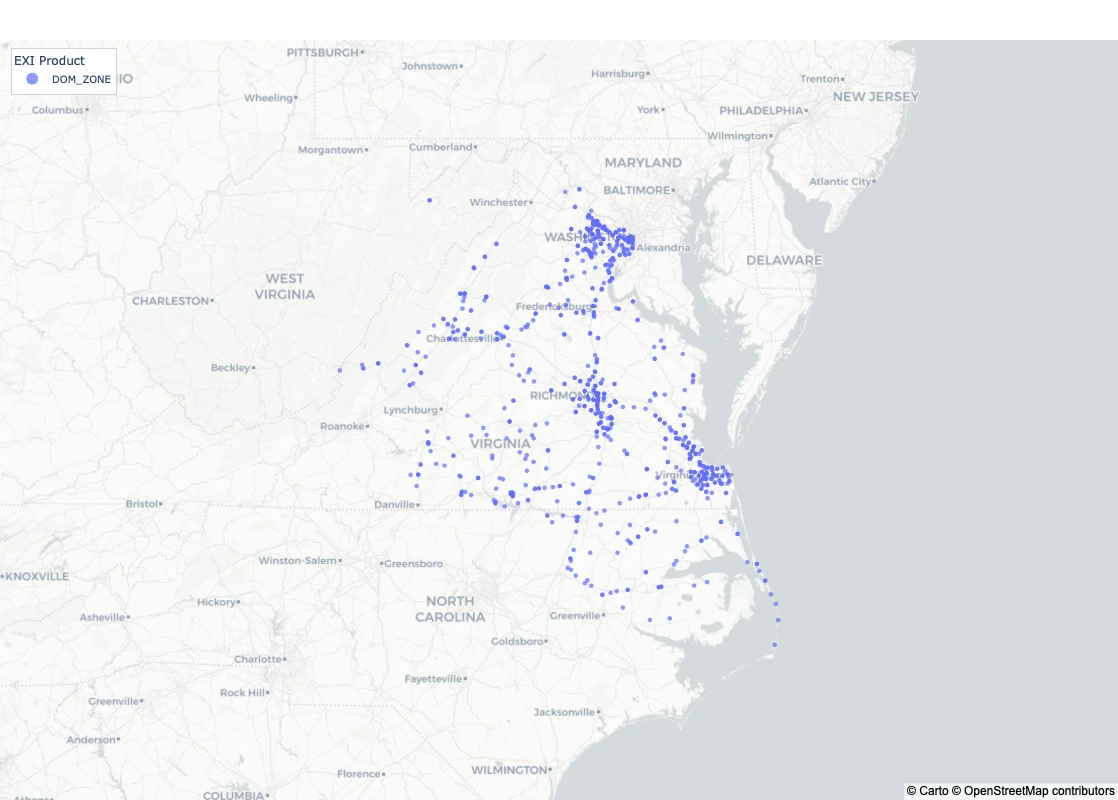
Data Center Alley
Location-inelastic, price-inelastic demand
Data center load violates the most basic assumption of commodity markets — that demand responds to price. Hyperscaler campuses in Ashburn cannot relocate once network connectivity, physical plant, and customer contracts are established; operators sign 10–20 year power purchase agreements and utility tariff contracts that lock in both location and load commitment. The incentive structure optimizes for uptime and latency, not power cost. A hyperscaler running $500M of servers does not curtail during a $500/MWh LMP spike. This price-inelastic demand at the margin is the foundation of the structural dynamic.
Scale
Current Northern Virginia inventory stands at roughly 4,500 MW of commissioned capacity — WTOP cites more than 4,900 MW — with a signed and announced pipeline suggesting another 3,000–5,000 MW under development. Individual campus-scale deployments are approaching 500 MW for a single tenant, such as the 450 MW TA Realty campus in Leesburg. For context, Loudoun County alone would rank among the largest power-consuming entities in PJM, ahead of most states or zones. Load density per square mile in the Ashburn–Dulles corridor is among the highest anywhere in the world, placing extraordinary demands on a transmission system never designed for this profile.
The interconnection queue as a forward indicator
PJM's generator interconnection queue — which includes large-load interconnection requests for data centers — gives a forward signal on Dominion Zone demand that is more reliable than weather forecasts. Active requests in the queue represent hundreds of additional MW expected online over the next three to seven years. Unlike merchant generation projects, which frequently withdraw, hyperscaler requests backed by signed utility service agreements have high conversion rates. The queue is the closest thing to a certain demand forecast that power markets ever see.
Always-on load profile
Traditional grid planning assumes load peaks during summer afternoons and troughs overnight. Data centers run at 90%+ capacity factors around the clock, and the overnight trough that grid operators rely on for maintenance windows and reserve margins is disappearing in Northern Virginia. In one recent instance, two local constraints in Data Center Alley bound at the PJM $2,000 limit, driving prices to roughly $1,500/MWh at 1:00 AM ET.
This flat, 24/7 profile interacts with variable renewable generation to create both new congestion patterns — overnight wind surplus into a system that cannot export it — and new shape dynamics, since duck-curve amplitude grows when the base never drops. Grid operators and traders alike are working with planning assumptions calibrated to a load profile that no longer reflects the zone.
Capacity markets: why Dominion opted out
The Dominion Zone is a Locational Deliverability Area (LDA) under PJM's Reliability Pricing Model, but Dominion Energy Virginia has elected Fixed Resource Requirement (FRR) status, opting out of PJM's Base Residual Auction. Under FRR, Dominion demonstrates capacity adequacy through its own integrated resource plan rather than relying on the competitive market to attract megawatts. When a utility facing 173% projected load growth concludes that the competitive capacity market is not the right mechanism to secure supply for its zone, it underlines the difficulty of the problem. The scarcity dynamic does not disappear under FRR — it migrates from auction clearing prices into rate cases, long-term contracts, and resource planning proceedings. Capacity market signals therefore do not reflect the Dominion Zone supply-demand balance as directly as they do in other PJM LDAs; the dynamic is expressed in energy and congestion pricing rather than capacity auctions.
Offshore wind
Virginia's Coastal Virginia Offshore Wind (CVOW) project — 2.6 GW at full build, the largest offshore wind project in North America — adds zero-marginal-cost generation near the zone's southern electrical boundary. The interaction with congestion is nuanced, and CVOW should not be viewed as straightforwardly price-suppressive for the zone.
CVOW interconnects near Virginia Beach, electrically and geographically distant from Data Center Alley more than 250 miles north. The path from interconnection to Northern Virginia traverses the same congested bulk system that already struggles to deliver power from western PJM. Adding generation at the southeast end of the system does not relieve the northwest-to-northeast interfaces that bind during peak Northern Virginia demand.
The seasonal dynamic matters too: Mid-Atlantic offshore wind is strongest in winter and weakest in summer, precisely when Northern Virginia demand peaks, so CVOW will not provide meaningful relief during heat dome events. Conversely, during high-wind overnight shoulder periods in spring and fall, zero-marginal-cost wind into a constrained export path can depress Dominion Zone off-peak prices in those hours. CVOW creates shape dynamics; it does not resolve the structural peak congestion problem.
Transmission challenges
"Not in my backyard"
Transmission infrastructure faces a political and regulatory gauntlet that generation never does. A new 500 kV line requires siting approval from every county, state, and landowner along its path, and at each step it meets organized opposition from residents who accept the abstract need for the line but reject the specific route crossing their property, their viewshed, or their county. That opposition is rational individually: the costs of a transmission line — land use, visual impact, perceived health concerns, property-value anxiety — are concentrated and local, while the benefits of lower regional prices and improved reliability are diffuse and regional. The people who pay the cost don't capture the benefit, and the people who capture the benefit don't pay the cost. That asymmetry produces fierce local resistance and sympathetic local officials, which in turn produces lengthy permitting proceedings, environmental challenges, route re-studies, and litigation.
PJM's RTEP shows delays of several years between approval and energization, and some projects have been in the queue for over a decade. Virginia has a better track record than most states given Dominion's size and its relationships with state regulators, but even within a single utility's footprint a new 500 kV corridor through Northern Virginia suburbs faces the same fundamental problem: the people most affected by the line are not the people most affected by the congestion it would solve.
Aging infrastructure and grid fragility
The challenge is not only that transmission capacity is insufficient relative to load growth. Much of the existing infrastructure is aging and increasingly brittle, and the geography of the zone compounds the problem. Large portions of the Dominion service territory are served by radial transmission lines feeding finger peninsulas with no redundant feed, including sections of the Eastern Shore, the Northern Neck, and the Middle Peninsula. When those lines trip, there is no backup path.
The 2022 Lanexa–Dunnsville 230 kV outage illustrated this directly: a single contingency on a line serving the Middle Peninsula produced conditions that would have been manageable in a meshed network but became acute in a radially served geography with limited options for restoring service. PJM and the Market Monitor intervened to prevent near round-the-clock binding of the Northern Neck constraint, with no opportunity for relief.
Replacing aging infrastructure in these corridors is not straightforward. New rights-of-way through tidewater Virginia and across water crossings are expensive, environmentally sensitive, and slow to permit. The result is a grid that is simultaneously undersized for future load and fragile at its existing margins.
Zone dynamics
Basis: Dominion Zone vs Western Hub
As load growth increases the frequency and duration of constrained hours, the annual average basis versus Western Hub has trended upward. During constrained hours the marginal generator serving Northern Virginia is a local gas peaker, not the combined-cycle or nuclear unit setting price at Western Hub, and the congestion component of the LMP is the premium required to bring that peaker online. More load against the same transmission infrastructure means more hours of peaker dispatch. The secular basis widening is the direct financial expression of the physical story. Notably, annual FTRs clear at a blended average that systematically underweights the summer peak congestion premium.
Dominion Zone vs Dominion Hub: a critical distinction
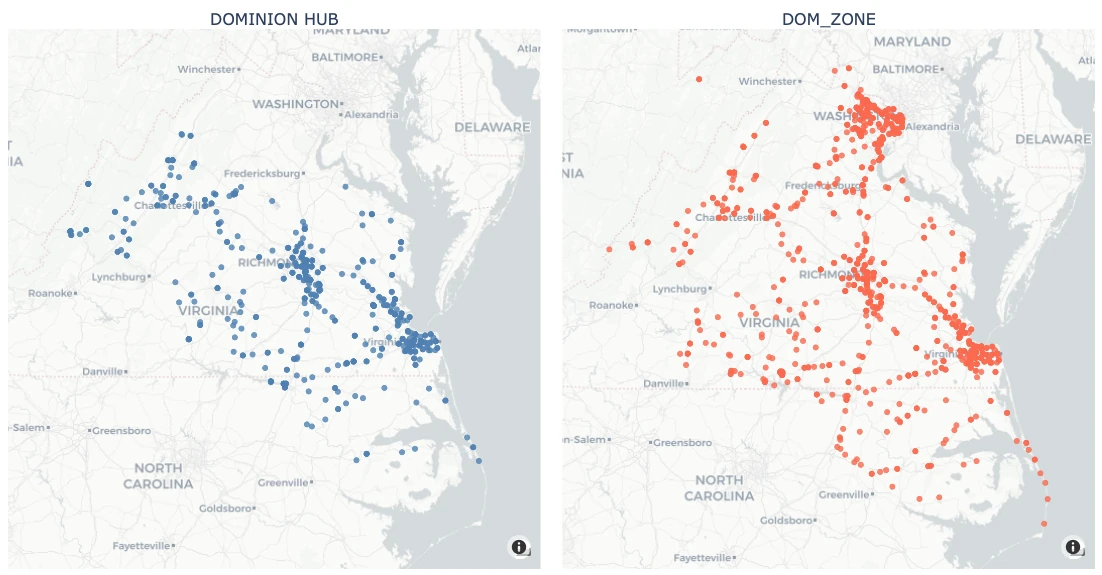
Dominion Hub covers mid- and southern Virginia and does not include Northern Virginia data center nodes; Dominion Zone includes the full Dominion footprint. The Hub-to-Zone spread is therefore a clean financial isolation of Data Center Alley congestion — the Dominion Hub to Dominion Zone UTC is the most-traded virtual path in PJM, at roughly 15% of all UTC volume.
Outlook
Several structural drivers in the Dominion Zone are expected to develop over the second half of this decade. Load is projected to grow as the signed interconnection queue, driven substantially by data center development, converts to metered demand. Approved transmission solutions from the current RTEP cycle are not expected to energize before 2030. Capacity auction results for recent delivery years have shown premiums in the zone: per PJM's Base Residual Auction reports, Dominion's LDA cleared at $444.26/MW-day for 2025/26 and at the $329.17/MW-day cap for 2026/27.
These drivers interact seasonally. Summer demand tends to rise year over year while transmission capacity remains largely unchanged until new projects energize, and offshore wind output is typically lowest during periods of peak summer demand. The local peaking stack has a marginal cost sensitive to natural gas availability on Appalachian basis (Transco Zone 5), which can amplify price formation during cold snaps and during summer heat that coincides with pipeline tightness.
Beyond 2030 this picture is expected to shift. Major transmission projects, once energized, may reduce peak congestion, and local generation additions — particularly battery storage and potential small modular reactor development — could change the merit order. These are developments to monitor as they progress.